Tzacatli
(tsah-KAHT-lee)
This is a Playtest Version. [2026.03.25]
The Dungeon Master reserves the right to make any alterations to this in order to keep the game balanced and fun for everyone.
Description
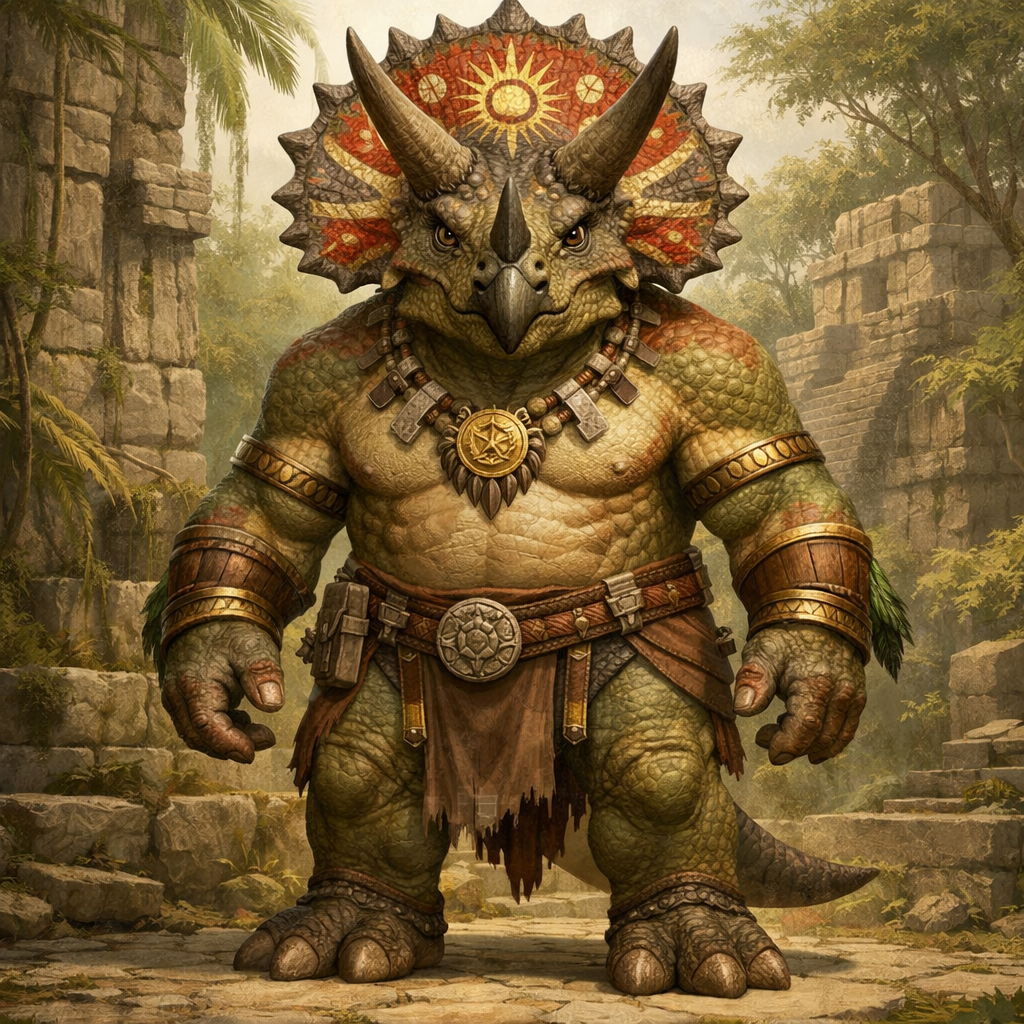
The Tzacatli are a broad-framed, horn-crowned people whose silhouettes evoke the ceratopsians that thunder through jungles and sacred roads. Their heads bear a triceratops's unmistakable signs: a hooked beak, a dense skull, a sweeping frill, and three prominent horns. Below that ancient profile, however, they are fully humanoid — thick-shouldered, steady-handed, and built for armor, weapons, ritual craft, and the hard labor of empire and survival alike. Their gait is upright and deliberate, their feet wide and weight-bearing, and their presence carries the feeling of something difficult to move once it has chosen its ground.
To mistake a Tzacatli for a brute is to misunderstand them. They are not creatures of frenzy, but of commitment. They prefer patience to posturing, endurance to bluster, and measured force to wasted motion. Many seem calm, even contemplative, until the instant action is required. Then that stillness breaks into terrifying momentum. A charging Tzacatli does not look wild. It looks inevitable.
Among the peoples of the world, the Tzacatli fit most naturally where stone, sun, and dinosaur might meet: temple roads half-swallowed by jungle, fortified causeways, caravan routes between imperial cities, sacred precincts where ancient vows are kept, and the outer settlements that survive by discipline more than comfort. In lands where dinosaur strength is honored, solar faith shapes kingdoms, and old ruins still hold power, the Tzacatli feel less like an oddity and more like something that was always meant to be there.
Appearance
Tzacatli bear the unmistakable profile of the ceratopsians — the hooked beak, the dense brow, the sweeping cranial frill, and three prominent horns (two long brow horns flanking a shorter nasal horn). Their hide ranges widely by lineage. Below the neck they are solidly humanoid in form: broad across the shoulders and chest, thick-limbed, and built for sustained effort. Their hands are fully functional and dexterous. Their wide, stable feet speak to generations of load-bearing, long marches, and ground that had to be held rather than retreated from.
Alignment
Tzacatli lean toward lawful alignments — not because they are rigid, but because they understand the value of structure, oath, and the long view. They trust patience more than passion, and tend to honor commitments made in full knowledge of the cost. That said, individuals vary: some channel that discipline into stern public service, some into quiet protection of those they love, and some into restless ambition sharpened by the sense that the world is changing and they must change with it.
Creating Your Tzacatli
A Tzacatli character might come from an imperial temple-city, a jungle fortress, a ruin-warding bloodline, or an isolated settlement that measures its ancestry in watch-posts and stone markers rather than written pedigrees. Some are raised to see themselves as guardians of sacred ground and living bulwarks of their people. Others are scouts, outriders, caravan wardens, beast-handlers, priests, masons, or soldiers who learned that endurance matters more than glory.
Your character's outlook may depend on what they believe strength is for. One Tzacatli might embody stern duty and public service, another quiet protectiveness, and another restless ambition sharpened by the sense that the world is changing. Some may be deeply loyal to a great empire and its sacred vision. Others might serve older local traditions, keep watch over places that empire only half remembers, or walk away from temple and throne alike in search of a destiny too large to remain rooted in one land.
Traits
- Creature Type. You are a Humanoid.
- Size. You are Medium.
- Speed. Your walking speed is 30 feet.
- Horns. You have horns that you can use to make Unarmed Strikes. When you hit with them, the strike deals 1d6 Piercing damage plus your Strength modifier, instead of the Bludgeoning damage normal for an Unarmed Strike.
- Rooted Frill. Your frill and low, powerful stance make you difficult to dislodge. You have Advantage on ability checks and saving throws you make to avoid being moved against your will or knocked Prone.
- Path of Stone and Root. Nonmagical Difficult Terrain composed of rubble, roots, or dense plants doesn't cost you extra movement.
- Sundering Rush. Once on each of your turns, if you move at least 20 feet in a straight line toward a creature and then hit it with your Horns on the same turn, you can force that target to make a Strength saving throw. The save DC equals 8 + your proficiency bonus + your Strength modifier. On a failed save, the target is either knocked Prone or pushed up to 10 feet away from you (your choice). The target must be no more than one size larger than you.
- Languages. You can speak, read, and write Common and one additional language appropriate to your homeland or service.
Appearance Variants
Suncrest Lineage
Ochre, gold-brown, or red-clay hide; polished horn caps; broad frills marked with radiant banding or painted solar motifs. These Tzacatli are often associated with temple service, imperial ranks, or ceremonial duty.
Deep-Ruin Lineage
Slate, basalt, or green-black hide; thicker frills; mineral-like speckling; heavier horn bases. Their look suits old wardens, tunnel scouts, and lineages tied to buried roads, sealed gates, or forgotten precincts.
Rain-Jungle Lineage
Mossy green, river-stone gray, or damp earth tones; slightly shorter but thicker brow horns; frill edges adorned with bright scales, feathers, beads, or carved bone. These Tzacatli are common among frontier settlements, jungle guides, and dinosaur-road keepers.
Names
Tzacatli names are drawn from the resonant syllables of their ancestral tongue — patterns of echoed consonants, open vowels, and endings that carry the sound of stone and ceremony.
Masculine Names
Apatzo, Caparo, Ixtal, Kinjat, Matoco, Otepan, Tilaco, Xacatl
Feminine Names
Caztali, Huatza, Ixanli, Nacaya, Otila, Pachati, Talcaya, Xinali
Gender-Neutral Names
Atzali, Capatli, Intali, Kinali, Orazi, Tazca, Tilan, Xocatl
Sample Character Concepts
Temple-Horn Sentinel
A heavily armored Tzacatli Fighter or Paladin who served as a guardian of a solar precinct before taking to the road. Stoic, disciplined, and slow to anger, they view battle as a sacred duty, not a thrill.
Causeway Reclaimer
A Tzacatli Ranger or Rogue raised among overgrown roads and broken stoneways leading toward ancient ruins. They know how to move through jungle-choked architecture, read old boundary markers, and drive enemies away with sudden, brutal commitment.
Star-Frill Wanderer
A Tzacatli Druid, Cleric, or mystic whose people taught that horn, frill, and footprint all mirror older cosmic patterns. They adventure to interpret omens, uncover buried truths, and decide whether the world's future belongs to empire, ruin, or something stranger.
Cultural Background
The cleanest way to place the Tzacatli is not as a hidden globe-spanning civilization, but as an old and respected people woven through the margins of great empires: temple wardens, frontier defenders, causeway keepers, dinosaur-road marshals, and guardians of sacred ruins. Some Tzacatli lineages preserve older rites tied to ancient ruins and the deeper holiness of the land itself — a spiritual connection rather than a political one. Some Tzacatli serve empire, some endure it, and some answer first to stone, sun, and sacred oath.
Their communities prize endurance above almost every other virtue. A Tzacatli settlement is measured not by its grandeur but by how long it has stood, how many attacks it has absorbed, and how faithfully its people have kept their vigil. That makes them natural records-keepers of hard-won ground: the passes held, the roads rebuilt, the precincts preserved against encroachment. To a Tzacatli, a wall still standing is a kind of poem.