Tarnuk
This is a Playtest Version. 2026.03.29
The Dungeon Master reserves the right to make any alterations to this in order to keep the game balanced and fun for everyone.
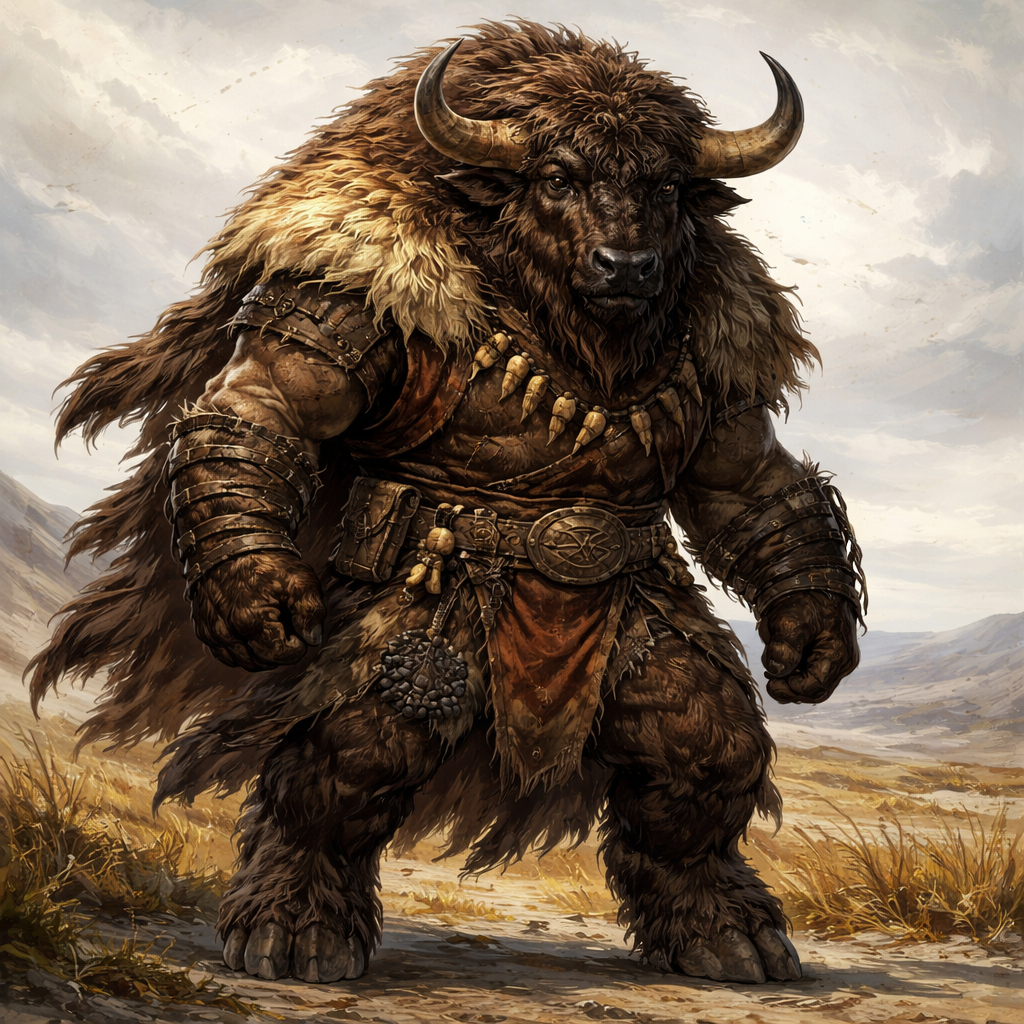
Description
The Tarnuk are broad-shouldered bison-folk whose strength is measured not only by force, but by what they can endure without yielding. Shaggy, thick-boned, and deeply communal, they are people of the open world: storm-tested wanderers, line-holders, and keepers of long memory.
Tarnuk are unmistakably bison-like. Their bodies are built around a towering shoulder hump, a thick neck wrapped in dense wool or mane, and a powerful upper frame that makes them seem half fortress and half living thunderhead. Their horns vary from clan to clan — some wide and sweeping, some short and blunt for ramming through drifts or brush — but even the leanest Tarnuk looks rooted to the earth in a way few folk do. Their legs are strong and hoofed, made for crossing open miles and holding ground when wind, snow, or enemies try to drive them back.
Where Minotaurs are often portrayed as abrupt, forceful, or labyrinth-bound, Tarnuk are people of the horizon. They are shaped by plains, high grasslands, cold steppes, rolling hills, and tundra roads where weather can kill the careless and distance humbles the proud. Tarnuk communities value patience, warning signs, shared burdens, and the old lesson that survival belongs to the herd before the self. Their oral traditions are rich with storm-chants, ancestral route songs, and remembrance rites in which the names of the dead are spoken into the wind so they are never truly lost.
Though outsiders often mistake them for stoic or severe, Tarnuk culture holds deep warmth beneath its stern exterior. Hospitality is sacred, endurance is admired, and abandoning another to danger is a mark of shame. A Tarnuk might be a caravan marshal, shrine-keeper, outrider, skald, druid, knight, monk, or scholar; what unites them is not a single vocation, but a shared instinct to stand fast when others falter. They are not merely horned folk with great strength. They are a people shaped by weather, distance, memory, and the duty of staying when staying matters.
Traits
- Ability Score Increase. Your Constitution score increases by 2, and your Strength score increases by 1.
- Age. Tarnuk mature around age 18 and can live for up to 150 years.
- Alignment. Tarnuk tend toward lawful alignments, shaped by the deep communal codes of herd life — shared burdens, kept oaths, and the duty of protection. Most lean toward good, though the harshness of the open country breeds pragmatists as well as idealists.
- Creature Type. You are a Humanoid.
- Size. Tarnuk stand between 6 and 7 feet tall and are powerfully built. Your size is Medium.
- Speed. Your base walking speed is 30 feet.
- Shaggy Hide. Your thick coat and dense hide shield you from the cold. You have Resistance to Cold damage.
- Open-Country Walker. Nonmagical Difficult Terrain made of snow, ice, loose earth, or undergrowth doesn't cost you extra movement. In addition, you have Advantage on Wisdom (Survival) checks you make to navigate, track, or forage in plains, hills, tundra, and other wide-open terrain.
- Massive Frame. You count as one Size larger when determining your carrying capacity and the weight you can push, drag, or lift.
- Plainsbreaker Stance. When you move at least 10 feet on your turn and end that movement on the ground, you can settle into a braced stance until the start of your next turn. While in this stance, your Speed is 0, and you can't be pushed or pulled against your will.
- While you are in this stance, enemies treat the ground within 5 feet of you as Difficult Terrain. In addition, when a creature of your choice starts its turn within 5 feet of you, that creature has Advantage on ability checks and saving throws it makes before the start of its next turn to avoid being pushed or knocked Prone.
- Languages. You can speak, read, and write Common and Tarnuk. The Tarnuk language is rich with oral tradition — its written form uses a system of carved marks passed down through clan elders.