The Ætherborn Kin is a loose, cell-based, deeply emotional, interventionist movement of Realmstriders who believe that power is meant to be used. Not carelessly, not always in the same way, and not under one unified code — but used nonetheless. To them, the existence of Realmstrider ability is not a burden that must mostly be denied. It is a calling, a gift, a responsibility, and in some cases a birthright that should never be surrendered to fear or philosophical paralysis.
That is why Kin matters so much. The name carries the idea that Realmstriders are bound together not by law, but by shared awakening. They are family in power, in exile, in burden, and in possibility. Where the Concord sounds institutional and restrained, the Kin sounds intimate and self-affirming. It frames the awakened not as dangerous anomalies needing discipline, but as people who belong to one another.
That makes them warmer, more human, more passionate — and more dangerous.
If you can help, how can you justify not helping?
That question is the heart of the Ætherborn Kin. It makes them easy to love in the moment and terrifying to reckon with over time.
The Kin are Realmstriders who reject the Concord's belief that non-intervention is the highest moral expression of power. They believe suffering, tyranny, collapse, invasion, and preventable destruction do not become sacred simply because they arise "naturally." In their view, refusing to act is still a choice — and often the crueler one.
The Kin draws in those who cannot tolerate the Concord's restraint. That includes:
Idealists and compassionate healers
Protectors and liberators
Rebels and militants
Wounded survivors who have seen too much preventable tragedy
Furious defectors from the Concord
Those who believe history can and should be changed by those with the power to change it
Unlike the Concord, they are not held together by a clean institutional center. They are held together by:
Shared belief in intervention
Action in the face of suffering is not a violation — it is a moral obligation.
Shared resentment of Binding
The Concord's greatest tool is the Kin's greatest horror. This wound never closes.
Shared identity as awakened beings
The Flare did not make them dangerous. It made them family.
Shared emotional conviction
Power unused where it could help is power betrayed.
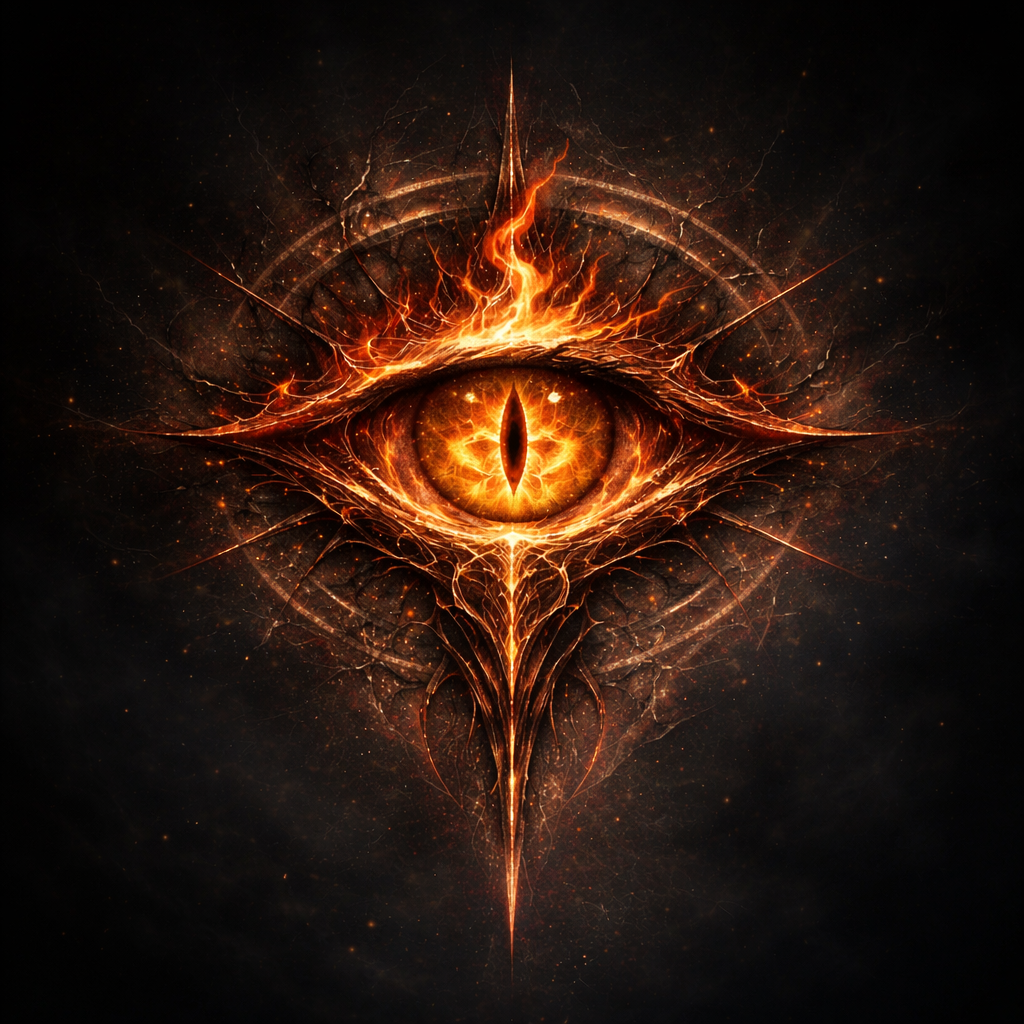
The Flaming Eye
The symbol of the Ætherborn Kin — representing the Flare, awakened sight, inner fire, and the claim that they are born into a higher condition of seeing and of acting.
The Flaming Eye is worn in two distinct ways, each carrying a different meaning:
Hidden on the body — Fellowship
Concealed beneath clothing or armor, the mark identifies one Kin member to another. It is a quiet oath shared without words — recognition among the awakened.
Worn openly on the forehead — Declaration and Defiance
The third eye. The awakened gaze. The refusal to pretend they are merely like everyone else. Worn openly, it is a statement of ideological allegiance and a challenge to the world.
That symbol alone tells you something the Concord never would: the Kin is comfortable — proud, even — with ideas of distinction, chosenness, and transformative identity.
The Concord trains people to restrain what makes them exceptional. The Kin teaches them not to be ashamed of it.
The Kin does not have one narrow doctrine of purpose. It embraces nearly all of them at once. To the Kin, Realmstrider power may be:
A gift meant to protect
Those who can shield others from harm bear a responsibility to do so.
A responsibility to shape better futures
Awakened power is not merely personal — it is generational. Use it to build something lasting.
A right of the awakened individual
The Flare was not given to be suppressed. It is the inheritance of those who bear it.
A means of correcting injustice
When ordinary people cannot right a wrong, those with transcendent ability are not exempt from trying.
A force that should not be restrained into passivity
Philosophical purity is not virtue when people suffer while you wait for the "right" moment.
This flexibility is one of their greatest strengths — and one of their greatest weaknesses. A compassionate healer, a militant liberator, a conquering visionary, and a furious avenger can all see themselves reflected somewhere inside the Kin. But that same breadth means the faction is never fully unified in motive. It is united by momentum and shared rejection more than by clean philosophical precision.
The Aegis Concord believes:
The greatest abuse of power is to steal destiny from others
Restraint is the highest moral expression of transcendent ability
Even benevolent intervention distorts mortal history
Freedom includes the freedom to fail — even catastrophically
The Ætherborn Kin believes:
The greatest abuse of power is to withhold aid while claiming moral purity
Intervention is morally legitimate in a way the Concord fundamentally denies
Refusing to act is itself a choice — often the crueler one
Power should answer suffering, not merely observe it
To the Kin, the Concord's doctrine is not noble restraint. It is often cowardice elevated into law — the comfort of philosophical distance purchased at the expense of people who bleed, starve, burn, and fall while someone with the power to help chooses not to.
That does not mean the Kin thinks every intervention is good. It means they believe intervention is morally legitimate in a way the Concord fundamentally denies.
The Central Question
While the Concord defends the right of peoples to determine their own fate, the Kin defends the idea that power should answer suffering — not merely observe it.
The Kin is not a stable order. It is a dispersed movement made of cells, bands, hidden meeting points, temporary alliances, and cause-based coalitions. It gathers where pressure is greatest — where Realmstriders feel the call to act.
This means it behaves more like a living insurgent network than a formal faction-state.
Mutual Aid Circles
Underground support networks for awakened Realmstriders — shelter, resources, and fellowship outside the Concord.
Intervention Teams
Militant cells that deploy into active conflicts to stop invasions, break sieges, or eliminate specific threats.
Ideological Circles
Philosophical communities that debate the right forms of intervention and recruit newly Flared Realmstriders.
Protectorates
Longer-term arrangements where Kin members take on guardian roles for specific peoples, regions, or nations.
Revolutionary Cells
Groups aligned with specific political causes — arming rebellions, supporting liberators, or toppling tyrants.
Lone Actors
Individual Kin who operate entirely on conscience, answerable only to themselves and the one sacred law.
Their practical doctrine is probably best stated as:
"If you have the power to change the outcome, your conscience must decide whether you should."
That is liberating. It is also a recipe for endless internal fracture.
The Absolute Prohibition
A Kin does not Bind another Realmstrider.
Cross this line — and the punishment is death.
The Kin does not share the Concord's restraint on intervention. It can stop invasions, overthrow tyrants, prevent apocalypses, arm rebellions, install rulers, create protectorates, and elevate chosen champions. Its range of justified action is immense. But it holds one prohibition as absolute:
This is not merely policy. It is the spine of the entire faction.
Why Binding Is So Hated
The Concord sees Binding as merciful, necessary severance: remove the power, spare the life.
The Kin sees Binding as something closer to existential desecration.
Because the Kin values Realmstrider identity above all else, Binding is not merely depowering. It is the stripping away of the very thing that makes an awakened being what they are. In their eyes:
Death preserves dignity. Binding erases it.
A Kin member will beg for death before accepting capture. They will kill another Kin before allowing them to be Bound. But they will not — under any circumstances — deliver a Realmstrider into what they see as spiritual annihilation.
This is why Kin members hunt those responsible for Bindings. It is not mere vengeance. It is religious, philosophical, and personal all at once. A Binder is not merely an enemy officer. They have committed the one act the Kin sees as unforgivable.
That also explains why the Binding process must be so heavily guarded by the Concord. It is not just dangerous in a practical sense. It invites blood feud.
The Tragic Code
Even in their most extreme internal conflicts — even removing an extremist who threatens the movement — a Kin will not Bind. They are willing to act violently, but they refuse the one punishment that denies the soul of what they believe themselves to be.
This is one of the most morally volatile parts of the Kin.
Unlike the Concord, which tries to subordinate Realmstrider power to restraint, the Kin clearly places greater value on the life of a Realmstrider — or a bound Strider — than on that of ordinary mortals.
That introduces a hierarchy into their worldview. Even if many Kin members sincerely protect mortals, they do not fundamentally see all life as equal. They see the awakened as something more consequential, more meaningful — perhaps more sacred — or at least more irreplaceable.
That does not automatically make them monstrous. But it means their compassion is not egalitarian.
This has real consequences:
They may justify mortal sacrifice in service of awakened goals
They may privilege Realmstrider freedom over social stability
They may see intervention as naturally theirs to decide
They may slip into paternalism, rulership, or conquest without feeling they have betrayed themselves
The Tragic Core
This is one of the reasons the faction can produce both saviors and tyrants without changing its core logic. A liberator can become a ruler. A protector can become a patron. A savior can begin to believe they alone deserve to decide.
The fact that dragons will not bond with Kin-aligned Realmstriders is one of the strongest metaphysical judgments in the setting.
The Kin respects dragonkind deeply — but cannot win dragon bond. That means the Kin has reverence without reciprocal affirmation. It honors something that does not choose it.
That creates a profound contrast with the Concord:
The Aegis Concord
Stabilized by dragon bonds
Elder continuity through ancient memory
Balanced perspective spanning generations
Institutional anchor against short-term urgency
The Ætherborn Kin
No dragon bonds — no equivalent anchor
No external check on passion and urgency
Driven by personality, cause, and immediate conviction
Powerful in motion, but unstable over time
Even neutral Realmstriders who bond with wyrmlings tend to form bonds of internal tension and clashing ideals — reinforcing that dragon bonds are inherently balancing. The Kin, denied that balance, remains more volatile, more fragmented, and more driven by the urgency of the present moment.
That makes them powerful in motion — but unstable over time.
The Kin's internal divisions are not signs of failure. They are structurally inevitable.
A movement built on intervention will always fracture over questions like:
Protect or Rule?
Where does guardian become governor?
Rescue or Reshape?
Do you pull people from danger, or redesign the danger?
Preserve or Revolutionize?
Is the goal to restore what was, or to build what should be?
Guide or Command?
When does counsel become authority?
Empower or Become?
Do you build up others — or become the power yourself?
Act or Withdraw?
After the crisis ends, do you leave — or stay to see it through?
Some Kin are true protectors who want only to act when needed and withdraw. Others become architects of entire orders, rebellions, kingdoms, or protectorates. Others drift into conquest and justify it as necessary stewardship. Others may become so extreme that fellow Kin remove them from the realms entirely.
Yet even amid all this fracture, the one shared law remains:
No Binding. Death Before Binding. Always.
That rule is the only clean spine running through a faction otherwise defined by passion, cell structure, and competing consciences.
The Kin sees itself through multiple overlapping heroic lenses at once. Different members stay for different reasons:
The Compassionate
Joined because of genuine love for those who suffer. They are the healers, the protectors, and the ones who weep when they cannot act in time.
The Furious
Joined in rage at Concord restraint or personal witness to preventable catastrophe. Their fire burns hottest and longest.
The Idealists
Believe power is meant to be used and that history can be improved. They are drawn to possibility before they are drawn to consequence.
The Guilty
Members who once stood aside when they could have acted. They will not make that mistake again — for better or worse.
The Bound
Those who have lost someone to Binding and carry that loss like a credo. They define themselves against the Concord more than they define themselves for anything.
The Ambitious
Those who are drawn to the freedom and identity the Kin offers — not purely for others, but for themselves. The most dangerous and the most honest.
The Kin is not emotionally cold. It is fueled by feeling. That gives it tremendous recruitment power — and tremendous vulnerability to the passions that consume movements from within.
Because Realmstriders are not broadly understood by the public, the Kin is usually perceived not as a known transplanar faction, but as powerful mages, miracle-workers, rebels, dangerous champions, or strange war-bringing figures.
To Those They Saved
Heroes. Liberators. Chosen of fate. People who answer prayers when no god does. Their gratitude can become dependency.
To Those They Disrupted
Agitators whose involvement escalated conflict and redrew power in ways nobody asked for. The cure that broke as much as it healed.
To Practical Observers
Walking instability. The kind of powerful outsider whose help always comes with hidden consequences no one fully understood until it was too late.
To the Aegis Concord
Dangerously self-justifying Realmstriders who mistake conviction for permission and compassion for legitimacy. Well-intentioned architects of chaos.
Their moral identity depends almost entirely on where one is standing when they act.
Strengths
Emotional power — the most compelling recruiting force in the world is shared grief and shared purpose
Decentralized resilience — no single center to destroy; cells survive and regenerate
Moral urgency — acts where others theorize; responds to crises faster than institutional orders
Broad ideological tent — protectors, revolutionaries, and avengers all find a home
The sacred law creates unity — the prohibition against Binding is the one clean spine in an otherwise fragmented body
Memory of Binding — their collective fury over this act keeps them motivated and dangerous
Vulnerabilities
No dragon bonds — no balancing wisdom, no long memory, no external anchor
Internal fracture is inevitable — Kin cells can and do end up on opposite sides of the same conflict
The liberator-to-tyrant slide — their own logic provides no internal brake against becoming what they opposed
Emotional fuel burns — the same passion that drives them can consume them
No unified standard of intervention — without shared doctrine, "good" intervention is defined by who is doing it
Public perception is volatile — savior today, destabilizer tomorrow
The Ætherborn Kin is a decentralized, cell-based revolutionary movement of Realmstriders who believe awakened power exists to be used in the affairs of worlds. Bound together by shared Flare, shared identity, shared opposition to the Concord, and shared rejection of Binding, they see themselves as kin not merely in blood or loyalty — but in awakening itself.
They are passionate where the Concord is restrained, personal where the Concord is institutional, and morally urgent where the Concord is patient.
Their great strength is that they refuse to stand aside.
Their great danger is that they may never know when standing aside would have been wiser.
They value Realmstrider life above mortal life, revere dragonkind but are never chosen by it, and will tolerate violence, conquest, and even internal killing before they will ever accept the Binding of one of their own.
Not observers. Not guardians. Not wardens.
The awakened family — too alive, too angry, and too certain to look away.
"Destiny is too often just the name people give to suffering that someone stronger refused to stop."